
FAQs
Urban Forest Master Plan FAQs
What is an Urban Forest Master Plan?
An Urban Forest Master Plan (UFMP) is a long-term roadmap for protecting, managing, and growing Orange County’s urban forest. It will establish a shared vision, goals, and priorities for caring for existing trees and planting new ones, while helping the County plan for future programs and funding.
The UFMP will also help guide tree-friendly design standards for neighborhoods, roadways, business centers, and other developed areas across Orange County.
What is an urban forest and where does it grow?
An “urban forest” is the collection of trees, shrubs, bushes, and other vegetation that grows in and around urban areas, along streets, between buildings and infrastructure, and in parks and green spaces. In Orange County, the urban forest grows in rural communities, suburban neighborhoods, and city centers. While traditional forests are concentrated areas, urban forests are broken up by the built environment, presenting extra challenges for planting and maintaining a healthy canopy.
What is canopy cover?
The tree canopy or canopy cover is the areas in Orange County that are shaded by trees. Imagine a sandhill crane flying, looking down over Orange County. The tree leaves and branches shading the ground are the tree canopy. A map that describes Orange County’s tree canopy cover, from areas of low cover to areas of high cover, is provided below.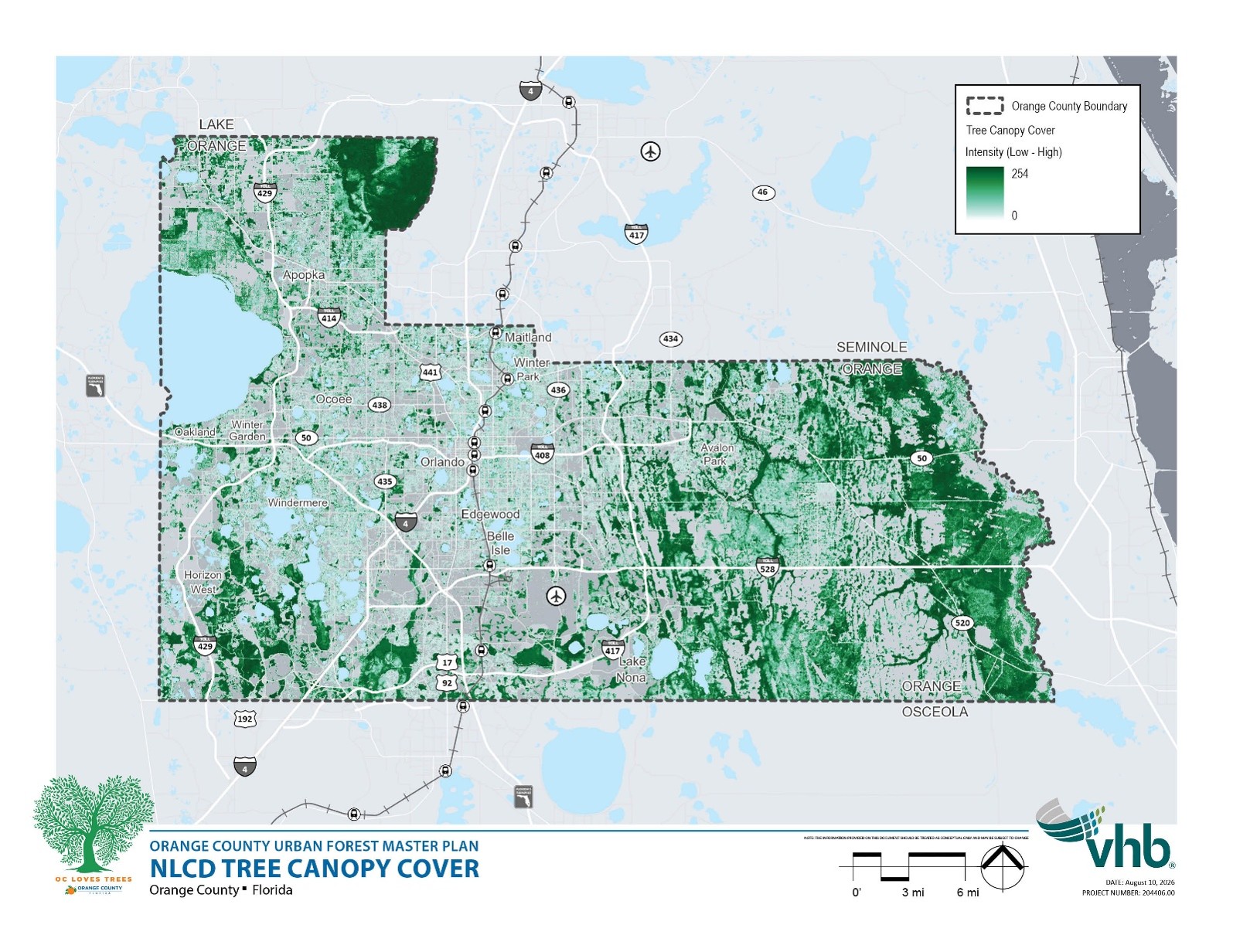
What is Orange County’s current tree canopy cover?
As of 2024, about 35% of Orange County is covered by tree canopy. The distribution of those trees is not uniform, as large clusters of trees are found in state and county conserved lands, with fewer located in developed areas.
What benefits from trees will we study with the development of the Urban Forest Master Plan?
The UFMP will study the benefits trees can provide, such as reduced flooding, lower surface temperatures, better air quality, improved safety for pedestrians and bicyclists, increased economic value, and the creation of more welcoming outdoor spaces.
What are Orange County’s goals?
Through the Urban Forest Master Plan, Orange County aims to create a greener, healthier and more resilient community by expanding and protecting tree canopy in neighborhoods, along streets and within natural areas.
As outlined in the County’s proposed Vision 2050 comprehensive plan, Orange County will strive to achieve an average 48% tree canopy coverage by 2050, with particular focus on areas where tree canopy coverage is 30% or less. The goal is to ensure more residents and communities benefit from the shade, cleaner air, stormwater protection, wildlife habitat and other benefits that trees provide.
Is this plan only about planting new trees, or does it address existing trees too?
The Urban Forest Master Plan will focus on both protecting and maintaining existing trees and identifying opportunities to plant new trees over time.
To help guide those efforts, Orange County will analyze data such as current tree canopy coverage, impervious surface coverage and available planting space. This information will help identify where trees are most needed and where investments can have the greatest impact.
The plan will also compare Orange County’s tree canopy and related metrics with similar counties in Florida, as shown below: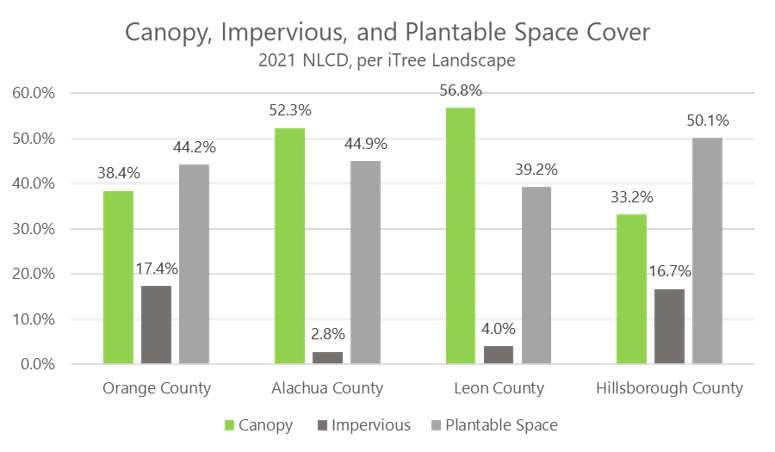
When will the Urban Forest Master Plan be complete?
The UFMP is projected to be complete in Winter 2027.
What does Florida-Friendly landscaping mean?
The Florida-Friendly Landscaping Program, created by the University of Florida Institute of Food and Agricultural Sciences (IFAS), promotes alternatives to conventional landscaping by following nine simple principles, including matching the right plant with the right place, and providing the right care at the right time.
How can the public get involved in development of the Urban Forest Master Plan?
You can get involved in the creation of the Urban Forest Master Plan in a variety of ways! Orange County will be hosting an in-person public workshop and a virtual webinar. We will also be asking questions and engaging with community members like you on Engage Orange throughout the project process.